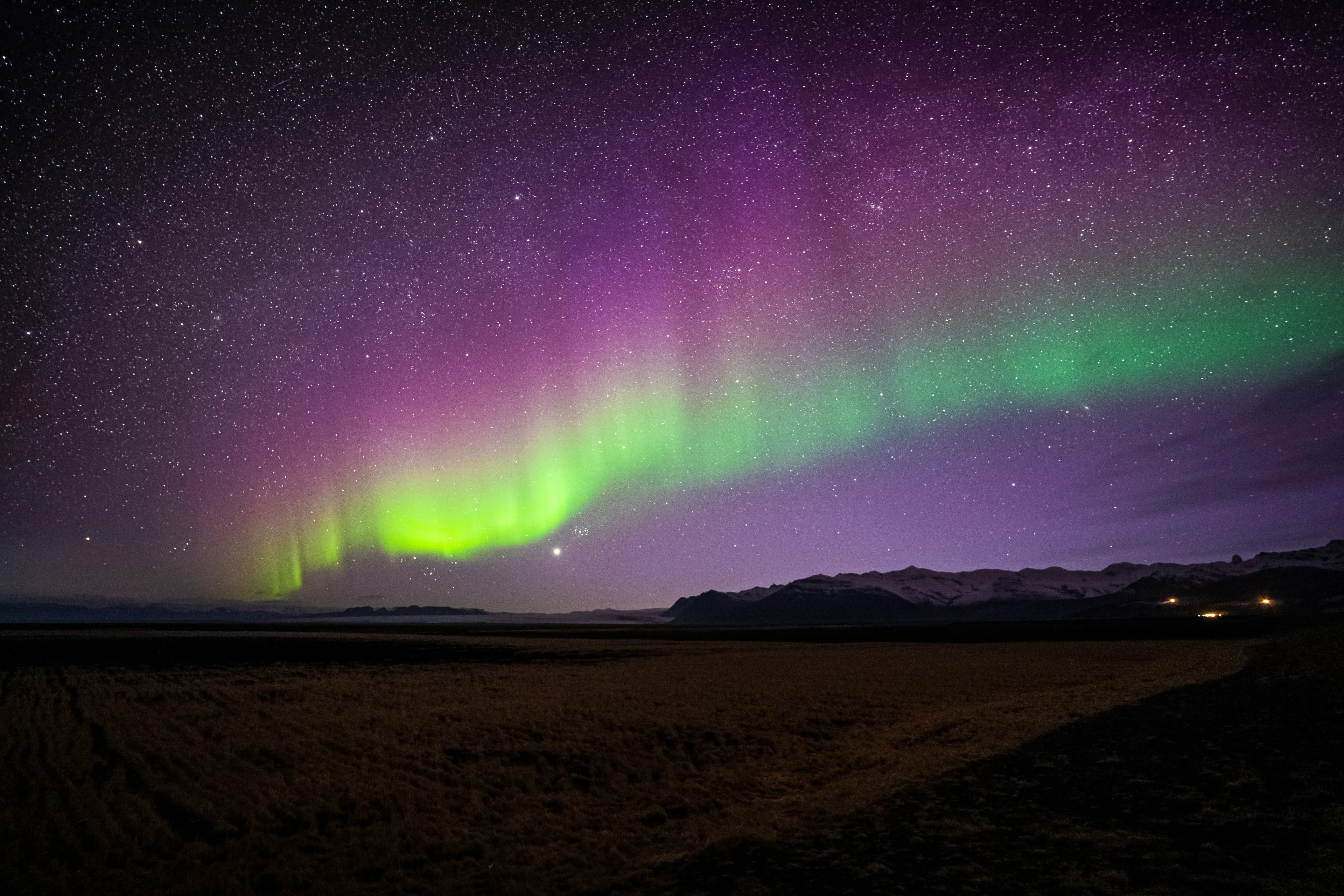
The KP index is the single most important number for aurora chasers. Here's what it actually measures, what each value means, and how to use it to plan your night.
If you've spent five minutes researching northern lights travel, you've encountered the KP index. It appears on every aurora forecast, app, and website — usually as a number between 0 and 9, sometimes with a coloured bar, sometimes with urgent alerts telling you that KP is rising. But what does it actually mean? And how should you use it when planning a trip?
The short version: KP measures global geomagnetic disturbance on a 0–9 scale. Higher means more aurora, visible further south. But the full picture is more interesting than that, and understanding it properly will make you a much better aurora chaser.
What KP Actually Measures
KP stands for "planetary K-index" — the "planetary" part matters. It's not a measurement from a single location, but an average derived from a network of ground-based magnetometer stations distributed across the globe, each recording changes in Earth's magnetic field. These changes are caused by the interaction between the solar wind — the constant stream of charged particles flowing from the Sun — and Earth's magnetosphere.
When the solar wind is carrying a strong southward-pointing magnetic field (called a negative Bz), it can connect with Earth's northward-pointing field through a process called magnetic reconnection. Energy pours into the magnetosphere, particles are accelerated toward the poles along magnetic field lines, and when they collide with atmospheric gases they produce the aurora. More energy = stronger coupling = higher KP = more aurora, visible at lower latitudes.
The index runs from 0 to 9. Values 0–2 represent quiet conditions. Values 3–4 are "unsettled to active." From 5 upward, the conditions are classified as geomagnetic storms: G1 (KP 5), G2 (KP 6), G3 (KP 7), G4 (KP 8), and G5 (KP 9). A G5 is the strongest possible storm — rare, but when it happens it can drive aurora as far south as the Mediterranean and the southern United States.
What Each KP Level Means in Practice
- KP 0–1: Quiet. Aurora only visible inside or very near the auroral oval — places like Tromsø, Alta, Abisko, Fairbanks, Yellowknife. Displays are often faint and low on the horizon even there.
- KP 2–3: Active. Good aurora at Tromsø, Abisko, Lofoten, Rovaniemi, Reykjavik. The oval expands slightly, producing brighter and more dynamic displays at typical destination latitudes.
- KP 4: Moderate storm. Excellent conditions across all Arctic destinations. Aurora becomes visible in northern Scotland (Shetland, Orkney) and southernmost Scandinavia.
- KP 5 (G1 storm): The aurora reaches cities like Bergen, Oslo, Stockholm, Helsinki, and Anchorage. Scotland, Iceland, and northern England all become viable.
- KP 6 (G2 storm): Northern Germany, the Netherlands, Poland, and northern Canada start seeing aurora. Overhead displays in Scandinavia.
- KP 7–8 (G3–G4 storm): Aurora visible across central Europe and the northern United States. Paris, Berlin, Prague — all viable on a clear night.
- KP 9 (G5 storm): The strongest possible storm. Aurora has been documented as far south as Florida, Texas, and southern Europe. These events are rare but occur a few times per solar cycle.
How the KP Forecast Works
NOAA's Space Weather Prediction Center issues KP forecasts based on data from the DSCOVR satellite, which orbits the L1 Lagrange point — a gravitational sweet spot between Earth and the Sun, roughly 1.5 million km upstream. DSCOVR measures the solar wind's speed, density, and magnetic field direction in real time, giving forecasters 15–60 minutes of warning before conditions arrive at Earth.
The key variable is Bz — the north-south component of the solar wind's magnetic field. When Bz turns negative (southward), geomagnetic activity rises rapidly. When it swings positive, activity dies down. Bz can flip within minutes, which is why aurora activity can start and stop suddenly mid-display.
Watch Bz, not just KP. The KP index is updated every three hours — too slow to catch rapid changes. Real-time Bz data from the DSCOVR satellite, available on PolarForecast, gives you a live view of whether conditions are building or collapsing.
KP vs Your Latitude: The Critical Relationship
The KP number alone doesn't tell you whether you'll see aurora — it has to be combined with your latitude. The auroral oval sits at roughly geomagnetic latitude 65–70°N. When KP rises, the oval expands equatorward. Each KP point corresponds roughly to a 2–3° shift in the oval's equatorial edge.
PolarForecast shows both the raw KP value and a location-specific visibility probability that combines KP with your geomagnetic latitude. This is the number to watch — it tells you not just "how active is it globally" but "how likely am I, specifically, to see something tonight."
Common Misconceptions
KP doesn't tell you how bright the aurora will be — it tells you how far south it extends. An enormous KP 1 display over Tromsø can be more visually dramatic than a faint KP 5 seen as a low smear on the horizon from Oslo. Brightness also depends on the altitude of the aurora, the specific mix of gases being excited, and local atmospheric clarity.
KP 5 doesn't automatically mean you'll see aurora in London or Berlin — cloud cover is still the overriding factor. Many G1 storms pass completely unwitnessed because the sky is cloudy. A clear night with KP 3 often produces better viewing than an overcast night with KP 7.
Frequently Asked Questions
Check the live Northern Lights forecast on PolarForecast — KP index, solar wind, cloud cover, and viewing probability updated in real time.
Check live forecast →