
The northern lights are a consequence of solar physics, planetary magnetism, and atmospheric chemistry all happening at once. Here's how it all connects.
Every aurora display starts 150 million kilometres away. The Sun is constantly losing mass — not through burning in the conventional sense, but through a sustained eruption of charged particles called the solar wind. This invisible river of electrons and protons flows outward in all directions at 400–800 km/s, reaching Earth in two to four days. Most of it slides around the planet, deflected by the magnetic field. But under the right conditions, some of it gets through — and that's when aurora happens.
Earth's Magnetic Shield
Earth is wrapped in a magnetic field generated by convection currents in the liquid iron outer core, about 2,900 km below the surface. This field extends into space as the magnetosphere — an asymmetric bubble that compresses on the Sun-facing side and stretches into a long tail on the night side. The magnetosphere deflects most of the solar wind around the planet, and without it, Earth's atmosphere would be slowly eroded away over millions of years.
But the magnetosphere is not impermeable. When the solar wind carries its own magnetic field pointing southward — the direction opposite to Earth's field at the boundary — a process called magnetic reconnection can occur. The two opposing fields link up, merge, and explosively reconfigure. Energy that was kinetic (in the moving solar wind) converts to electromagnetic energy inside the magnetosphere, and particles are accelerated inward along magnetic field lines toward the polar regions.
The Role of Bz: The Invisible Aurora Switch
Bz is the north-south component of the solar wind's interplanetary magnetic field (IMF). When Bz is positive (northward), it aligns with Earth's field and little reconnection occurs — conditions are quiet. When Bz turns negative (southward), the fields oppose each other and reconnection can begin. The more negative Bz is, and the longer it stays negative, the stronger the geomagnetic disturbance.
This is why real-time Bz monitoring is more useful than looking at a lagging KP forecast. Bz can flip from −20 nT to +5 nT in minutes, shutting down an active display, or swing from neutral to −30 nT and trigger an unexpected storm. Aurora chasers who watch Bz instead of just KP respond faster and waste fewer nights.
Why Do the Lights Form at the Poles?
Earth's magnetic field lines converge toward the magnetic poles. When accelerated particles travel along these lines, they're channelled toward the polar regions and concentrated into two oval-shaped bands — one around each magnetic pole. These auroral ovals sit at roughly geomagnetic latitude 65–70°N and 65–70°S. Within these ovals, particles hit the atmosphere most frequently and with the most energy.
The magnetic poles don't align perfectly with the geographic poles — the northern magnetic pole is currently in the Canadian Arctic, which is why locations like Yellowknife and Churchill in Canada have geomagnetic latitudes higher than their geographic position suggests, and why they're exceptional aurora destinations despite being at 63°N geographically.
What Causes the Colours?
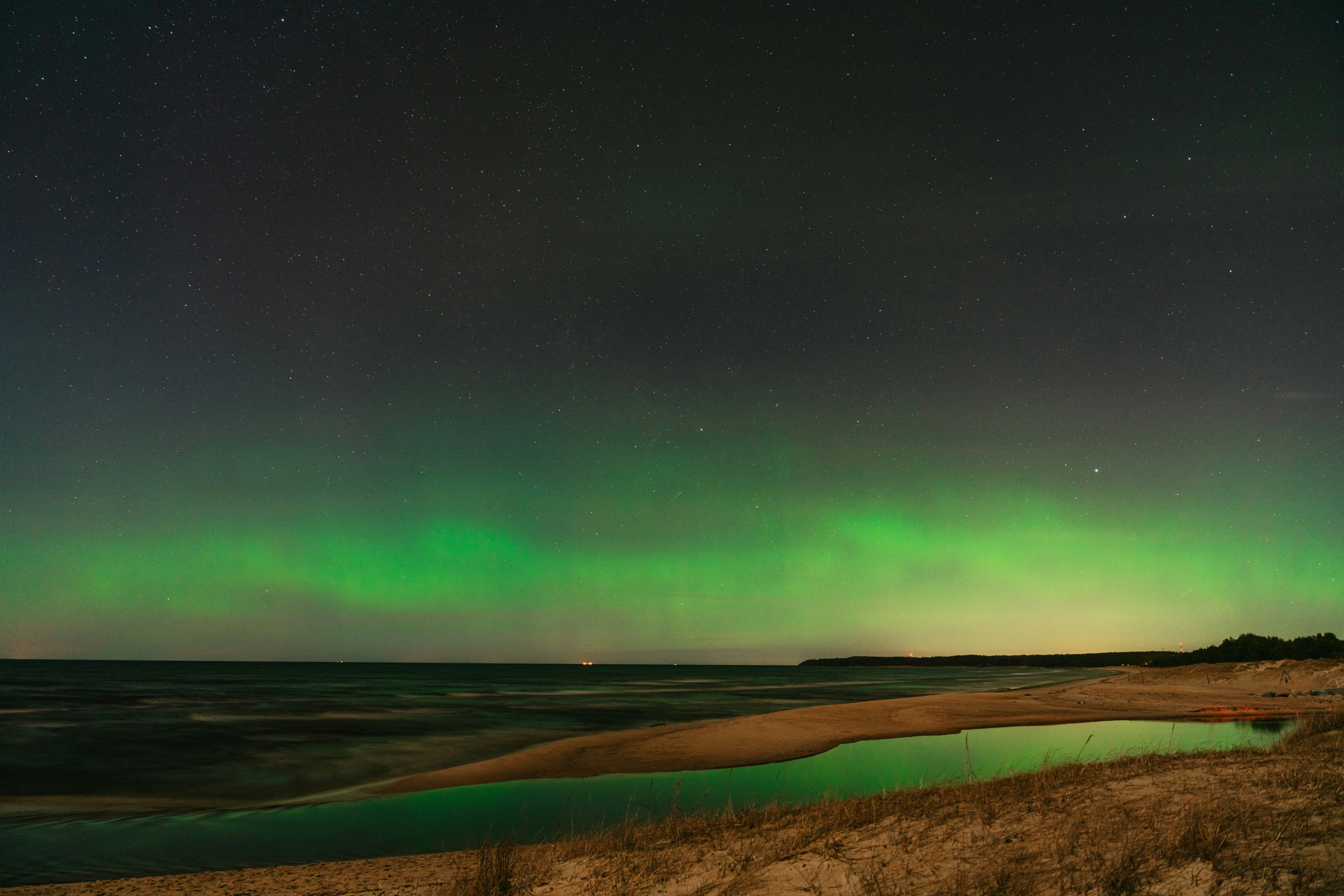
When energetic particles collide with atmospheric gas molecules, they transfer energy to the molecules' electrons, kicking them into excited higher-energy states. When those electrons return to their ground state, they release that energy as light — photons with specific wavelengths corresponding to specific colours. The colour depends on which gas is being excited and at what altitude.
- Green (557.7 nm): The most common aurora colour. Produced by oxygen atoms at altitudes of 100–150 km. The human eye is most sensitive to this wavelength, making it the most visible.
- Red (630 nm): Produced by oxygen at higher altitudes (200–300 km). Rarer and often visible only in strong storms or at the top of tall aurora curtains. Cameras capture it more easily than the eye.
- Blue and purple: Produced by nitrogen molecules, usually at lower altitudes (below 100 km). Often seen at the lower edges of active aurora during strong events.
- Pink/magenta: A mixing of red and blue/violet at the lower borders of strong displays. Often visible during significant storms when the aurora dips lower into the denser atmosphere.
- White: Rare, seen during exceptional events when multiple wavelengths blend. Often appears in time-lapse photography of very active storms.
Solar Storms and Coronal Mass Ejections
Beyond the steady solar wind, the Sun periodically ejects enormous clouds of magnetised plasma called coronal mass ejections (CMEs). A CME can carry 10–100 times more particles than the regular solar wind, and when it's directed toward Earth and carries a southward magnetic field, it produces major geomagnetic storms — the events that drive KP 6, 7, 8, or 9 readings and produce aurora visible from mid-latitudes.
CMEs are associated with solar flares — explosive releases of electromagnetic radiation from active regions on the Sun. X-class flares frequently accompany significant CMEs. A flare's X-ray emission reaches Earth in 8 minutes (travelling at the speed of light), giving advance warning that a CME may follow 1–3 days later.
The 11-Year Solar Cycle
The Sun's activity waxes and wanes on an 11-year cycle driven by changes in its internal magnetic field. At solar maximum, the Sun has more active regions, more flares, and more CMEs — and aurora is correspondingly more frequent and intense. At solar minimum, activity drops significantly.
Solar Cycle 25 (the current cycle) peaked in 2024–2025, making this an unusually active period for aurora. The May 2024 G5 storm — the strongest in 20 years — produced aurora visible across the United States, Europe, and Australia simultaneously. If you've been thinking about an aurora trip, the next few years represent a historically favourable window before activity begins declining again.
Frequently Asked Questions
Check the live Northern Lights forecast on PolarForecast — KP index, solar wind, cloud cover, and viewing probability updated in real time.
Check live forecast →